Diamond Clarity Scale and Chart: All 11 Grades Explained
A comprehensive guide to the art and science of diamond clarity
- Clarity reflects internal (inclusions) and external (blemishes) flaws.
- Graded from Flawless (FL) to Included (I3).
- Many inclusions are unseen without magnification - we call this "eye-clean"
- Higher clarity increases rarity and price.
- Choose clarity based on look and budget.

By Dr. Rian Mulcahy, PhD. Updated: November 2026
The diamond clarity scale grades how free a stone is from inclusions and blemishes when viewed at 10x magnification. GIA's scale has 11 grades in 6 categories, from Flawless (FL) at the top, through VVS, VS and SI, down to Included (I3). Most diamonds graded VS2 or better look clean to the naked eye.
Fast Facts on the Diamond Clarity Chart
- A clarity grade describes how many imperfections a diamond has and how easy they are to see.
- Those imperfections are either inclusions (inside the stone) or blemishes (on the surface).
- "Eye clean" means the inclusions cannot be seen without magnification, and that is the standard most buyers should aim for.
- Used well, the clarity scale saves you money. Used badly, it buys you a dull looking stone.
Clarity Grades Explained
Let's start with the basics. When we talk about clarity, we are referring to how many (or how few) natural imperfections are present in the stone. Imperfections inside a diamond are called inclusions, and imperfections on its surface are called blemishes. These imperfections can be your wallet's best friend or worst enemy, depending on how you use them. By now you have probably come across the ubiquitous, and slightly oddly worded, GIA scale from the Gemological Institute of America (slightly included, very slightly included, very very slightly included). Just in case you have not, here is the full diamond clarity chart.
Diamond Clarity Chart
This diamond clarity chart lists every grade on the GIA scale, what a trained grader sees at 10x magnification, and whether you can expect the diamond to be eye clean.
| Grade | Category | Visible at 10x | Eye clean |
|---|---|---|---|
| FL | Flawless | No inclusions and no blemishes | Yes |
| IF | Internally Flawless | No inclusions, only tiny surface blemishes | Yes |
| VVS1 | Very Very Slightly Included | Minute inclusions, very difficult for a grader to find | Yes |
| VVS2 | Very Very Slightly Included | Minute inclusions, difficult for a grader to find | Yes |
| VS1 | Very Slightly Included | Minor inclusions, hard to see | Yes |
| VS2 | Very Slightly Included | Minor inclusions, somewhat easy to see | Usually |
| SI1 | Slightly Included | Noticeable inclusions | Often |
| SI2 | Slightly Included | Noticeable inclusions, easy to see | Sometimes |
| I1 | Included | Obvious inclusions | Rarely |
| I2 | Included | Obvious inclusions that may affect brilliance | No |
| I3 | Included | Obvious inclusions that affect brilliance and durability | No |
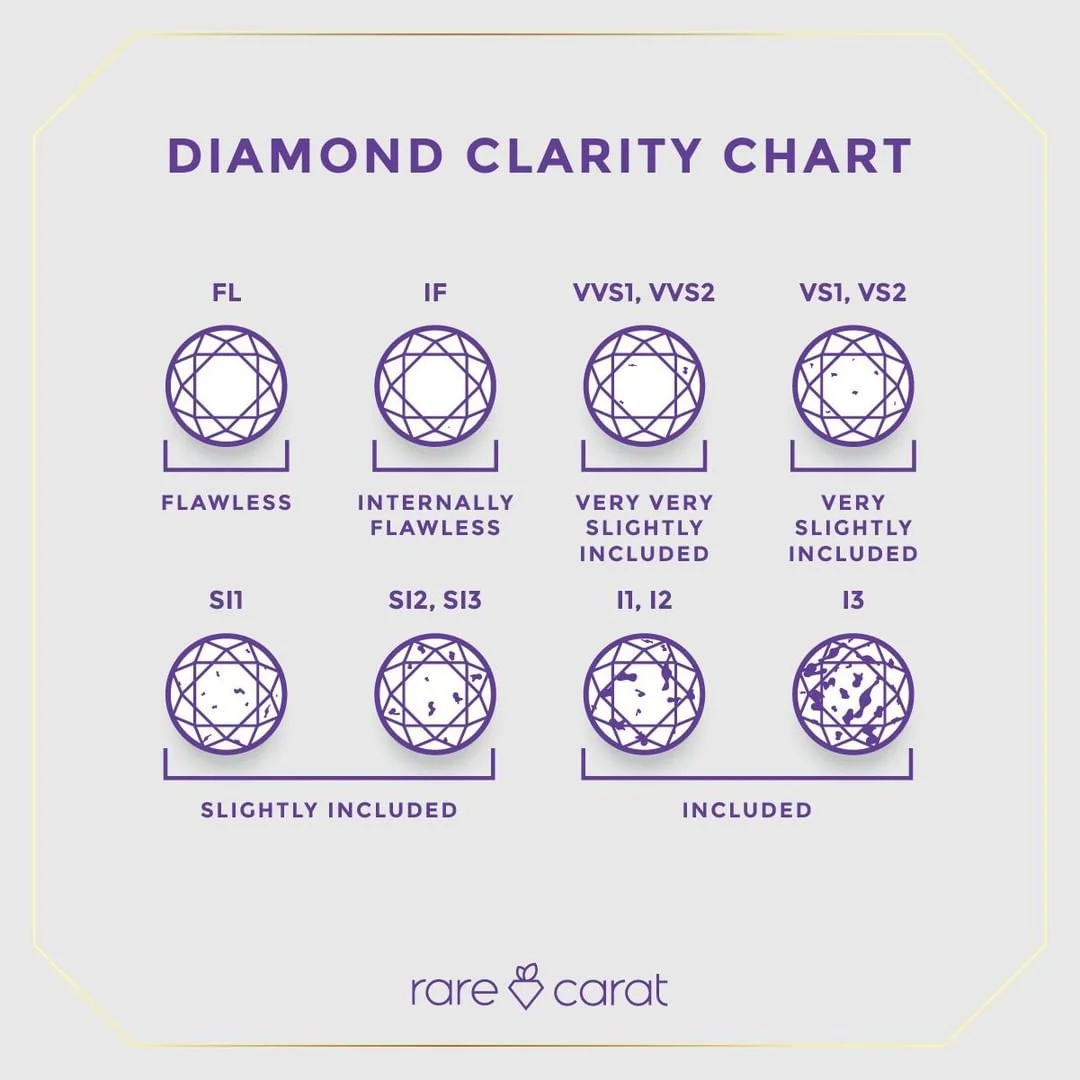
What are the 11 diamond clarity grades?
Six categories, 11 grades. Reading down the diamond clarity chart, here is what each one means in practice.
FL (Flawless)
Completely free of inclusions and blemishes at 10x magnification. Flawless diamonds are incredibly rare and priced accordingly, and to the naked eye they look identical to the grades just below them.
IF (Internally Flawless)
No inclusions inside the diamond, just some very minor surface blemishes that are difficult to see even for a trained eye at 10x. Every IF diamond is eye clean.
VVS1 & VVS2 (Very Very Slightly Included)
Microscopic inclusions that are difficult even for a trained grader to find under 10x magnification. All VVS diamonds are eye clean, whether brilliant cut or step cut.
VS1 & VS2 (Very Slightly Included)
Minor inclusions that range from hard to see at 10x (VS1) to fairly easy for a trained eye to spot at 10x (VS2). VS1 and above will be eye clean in brilliant cuts and most step cuts. The VS range is the most searched range on Rare Carat.
SI1 & SI2 (Slightly Included)
Inclusions are noticeable at 10x, and if you look hard enough you may see them with the naked eye. If they stay hidden, an SI stone is a great value. This range suits brilliant cuts better than step cuts, which hide much less.
I1, I2 & I3 (Included)
Inclusions that are easily spotted without magnification. Included diamonds are also less durable because of the number and type of inclusions. Rare Carat does not sell I clarity diamonds.
Which clarity grade is the best value?
The diamond clarity chart tells you how a stone was graded, not how it looks on a hand, so here is a small home truth. Worrying about inclusions in a diamond graded above VS2 is probably not the best use of your time. Anything from VS1 up to FL is going to be eye clean, meaning the inclusions will definitely not be visible to the naked eye (not even to the beady eyes of your cousin Brenda). At the other end, finding a good quality diamond in the I1, I2 or I3 grades is like finding a parking space at Walmart on Black Friday: not impossible, but time consuming and kind of depressing. Inclusions in this range are usually visible to the naked eye, and they can be prominent enough to disrupt the way light travels through a stone, ruining the fire and brilliance that make a diamond beautiful in the first place.

If you want a higher clarity stone, that is completely fine, and many people want the absolute best their money can buy. Just go in with your eyes open, knowing that you are most likely paying for a feature that will not be noticeable to the untrained or unaided eye.
Which brings us to the sweet spot. VS2 and SI1 are the holy grail of the clarity scale. Within this range you are most likely to find a gorgeous eye clean diamond that does not cost the same as a small car. You can see how wide the spread is by comparing a few 1 carat diamonds side by side across the VS2 to SI1 range. It is also possible to find I1 diamonds that are pretty, especially if you do not mind a few character flaws, and occasionally an I1 hides its flaws from the naked eye despite obvious inclusions at 10x. Think of it as the diamond equivalent of the classic movie makeover scene.
Landing in the VS2 to SI1 range does not mean you are home free, though. Just like the opening scene of Raiders of the Lost Ark, there are pitfalls and traps that many before you have fallen into. So before you take the plunge, here are the things to check about the inclusions themselves.
There are Five Factors When Considering Inclusions
- Size: The larger the inclusion, the easier it is to see and the lower the grade.
- Number: Typically, the more inclusions the lower the grade, but this depends on the other factors. A VS1 can have 5 pinpoints while a VS2 has two crystals, because crystals are larger (and usually darker) than pinpoints, so the stone with 2 inclusions still gets the lower call.
- Location: Where are the most prominent inclusions? Under the table they are easier to see than near the girdle or in the pavilion (the bottom).
- Nature: The type of inclusion determines how much of a durability risk it poses. A pinpoint is far less of a risk than a cavity.
- Color and Relief: The darker the inclusion, the easier it is to see. Relief describes how well the inclusion blends in with its surroundings.
What Size are the Inclusions?
Size matters most in the mid range, from VS2 to SI2, when you are trying to work out whether a stone will be eye clean. Remember too that the bigger the carat weight, the easier it is to see inclusions. A large, dark crystal smack in the center of a 5 carat diamond will be far more visible than the same crystal in the center of a 1 carat. To be safe, go for at least a VS2 if you are buying over 1.5 carats. Now let's compare apples to apples and look at two 1 carat stones.

This first diamond (we'll call it diamond A) has large, black inclusions (circled in red) scattered throughout it. They are also reflecting (more on that in the next section).

This second diamond (diamond B) has more inclusions, but they are a lot smaller, so they are harder to see.
Both of these stones are 1 carat SI1s, yet they look very different because of the size of the inclusions and the other factors below.
How Many Inclusions are There?
Not only do we care about the size of the inclusions, but also the amount. One large, dark crystal in the center can be worse than 5 small light crystals at the sides. We also need to consider reflections. Sometimes a crystal sits in just the right spot that its reflection bounces off the facets, making it look more included than it actually is. Look again at diamond A and you'll see what I mean: all of those red arrows point at reflections, not actual inclusions. Pretty crazy, right?
Where are the Inclusions Located?
Location is crucial both for looks and for durability. If a fairly large inclusion sits where an engagement ring setting will disguise it, that diamond might be a great option for you. If the same flaw sits in the center of the table, not only will you see it more easily, it can also hamper the way light travels through it. On the durability side, inclusions near the girdle (the edge) leave a stone more vulnerable to chipping over time, even in the most responsible of hands.

What Type of Inclusions (nature)?
Just like potential mates, there are many types of inclusions and not all are created equal. Some are tiny flaws (didn't wash your cup after coffee? No biggie), while others are glaring issues that need to be someone else's problem. You might have a diamond with a large crystal that is almost translucent and therefore barely noticeable (the dirty coffee cup scenario). Or the crystal might be black, which is not only noticeable but can reflect internally so it looks like there is more than one.

What Color are the Inclusions?
Black or dark inclusions are easy to see. Colorless or white inclusions blend in with their surroundings and are much harder to spot, which is exactly what you want.
Using everything you have just learned about location, size, amount, color and nature, do you prefer diamond A or diamond B? I'll take the one on the left, please!

Are inclusions bad in a diamond?
Not at all. Most of us will buy a diamond with some inclusions. The more there are, the lower the grade and the lower the price, but what matters is that they are not noticeable and do not threaten its durability. Inclusions can even be useful: when you leave your ring at a jeweler for repairs, being able to find a specific inclusion under magnification is a handy way to confirm the diamond that comes back is yours.
Which inclusions are the worst?
Anything that can cause a durability problem: cavities, knots, etch channels, laser drill holes and chips. All of these are holes, or can become holes if hit with the right amount of force, so avoid them whatever their size. It is also wise to avoid inclusions near the corners or points of fancy shapes, where chipping is more likely. The gentler inclusions are pinpoints, feathers, naturals and indented naturals, which are hard to see with the naked eye. Clouds are fine alongside other inclusions, but a stone whose only listed inclusion is "cloud" deserves a closer look, because a large cloud can make the whole diamond look hazy.
Do inclusions get worse over time, and do they affect sparkle?
Most inclusions never change. The exceptions are the durability inclusions above, which can grow after a hard knock. As for sparkle, a few minor inclusions will not visibly affect brilliance. It is only in the Included range (I1 to I3) that enough light hits the inclusions and escapes out of the sides or bottom instead of returning to your eye, that you notice reduced fire and brightness.
Let's Talk About Clarity Plots
A clarity plot is the little diagram found on most grading reports for diamonds of 1 carat or more. It is basically a map of where the inclusions sit within the diamond. Think of plots like movie trailers: a great way to get your bearings and know what to expect, but sometimes misleading, because a plot cannot tell you what a stone looks like in real life. Let's look at an example.

The plot looks promising, with only a few small crystals dotted around the center of the table. The real thing is a bit of an anti-climax, because the plot did not tell us those crystals were black and reflecting in a way that makes everything look even dirtier. On the other hand, a messy plot does not have to mean a bad looking diamond. Let's take a look at our "coffee cup in the sink" diamond.

On the plot alone this diamond looks like all types of trouble, but in real life it isn't that bad. Add the fact that this photo is at 10x magnification, and those inclusions will be hard to spot with the naked eye.
Both of these diamonds are graded SI2 but perform very differently. Because grading is not an exact science, and because each grade is a range, our coffee cup diamond might sit on the cusp of SI1 while the other sits on the border of I1. This is very important to understand when you are presented with a list of diamonds that look identical on paper but are priced differently. Look closer and they may turn out to be less Mary-Kate and Ashley Olsen and more Arnold Schwarzenegger and Danny DeVito.
The moral of this very long story? Relying on a grading report and the diamond clarity chart alone is a bad idea. Use it as a tool, but to get the best bling for your buck make sure you have access to a 10x magnified image or 360 degree video at the very least, and if anything is unclear, ask a gemologist. That way you can identify those pesky DeVitos.
Until next time (I couldn't resist, nor should I)...
Read More...
Which Diamond Inclusions are the Worst?
Whats the best cut grade for the shape? Rare Carat Ideal! Check it out here
Which is clearer, VS1 or VS2?
What type of diamond clarity is best?
What clarity grade do luxury jewelers use?
What is a poor man's diamond called?
Is SI1 clarity eye clean?
